
THE PARADISE OF CYRUS
LADAN SEDIGHI
SEPT 26 - DEC 5, 2026
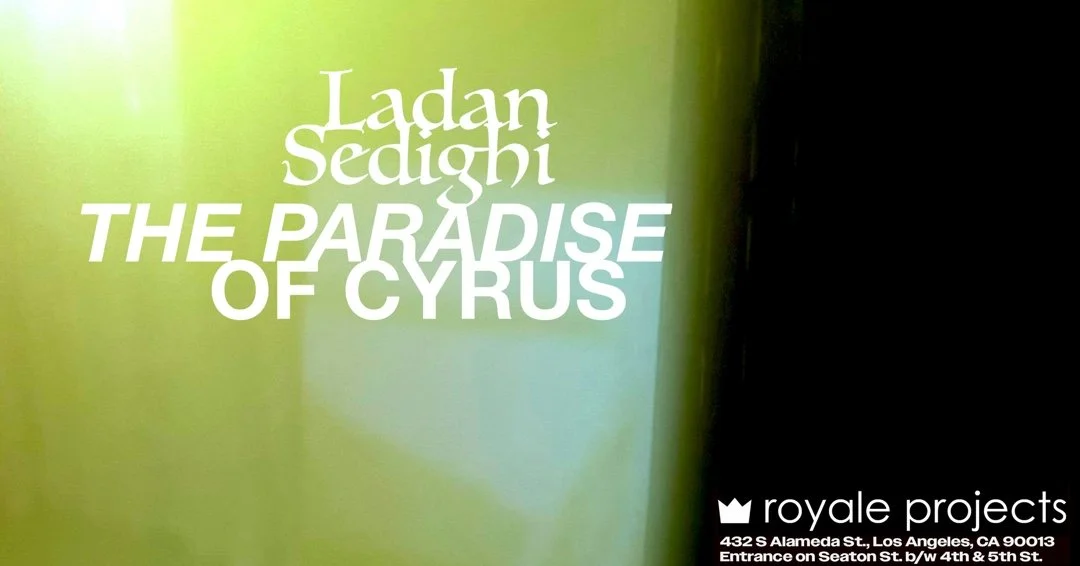
"Sedighi choreographs us by choreographing her elements... a neutral gridded network that in her hands does not long remain
neutral.” - Peter Frank (art critic)
LOS ANGELES, CA. Royale Projects is pleased to present The Paradise of Cyrus, a new body of work by Ladan Sedighi, opening
September 26, on view through December 5, 2026.
Sedighi works within the lineage of Southern California minimalism, precise, geometric compositions built to hold and release light, adiscipline she trained in during her MFA at Claremont Graduate University. Her starting point, though, is drawn from the luxury and decadence of her own Iranian heritage: antique jeweled brooches and pins, valued not for their imagery but for what she describes as "the constant movement in them of light and reflection. " That movement, not the object, is her real subject, and her intent toward it is explicitly ahistorical. She severs the object from designer, provenance, and narrative, delivering only what she calls "the effect of what is right before one's eyes.” The register she wants is joy, a departure from minimalism's usual austerity, drawn from a wider Persian inheritance: painting, jewelry, tiling, textiles, and architecture, mined for color and texture rather than pattern to be quoted.
That heritage gives The Paradise of Cyrus its title and its structure. Sedighi traces the word paradise back through the chahar bagh, the four-part Persian garden plan, and the qanat systems that made such gardens possible, from Cyrus the Great's garden at Pasargadae through Shiraz, Esfahan, the Alhambra in Spain, and the Taj Mahal in India. "Persian gardens have a profound place in the history, art, and culture of Iran," she says. "More than simply beautiful landscapes, they represent an enduring vision of harmony
between nature, architecture, water, geometry, and human experience. " Their afterlife is what holds her: "The rhythm, symmetry, and balance found in Persian gardens, and their interpretations (in miniature painting, textiles, rugs, and tiles,) continue to influence the way I see and understand space, form, and composition in my own work."
She delivers that inheritance into an entirely industrial vocabulary, holographic film, vinyl wrap, and acrylic sheeting, materials pulled from car culture and commercial signage, organized with the rigor of a minimalist into columns, blocks, bands and interrupted grids. Critic Peter Frank places the work at the meeting point of finish/fetish and light and space specifically, the two strands of 1960s Southern California minimalism most concerned with surface and perception, and describes her as an artist restoring "retinal pleasures usually alien" to a material history he calls "crude, industrial, even debased."
The paradise the artist seeks to share is not a place but an effect, joy without explanation. The brooch's flash, the shimmer of the garden's water and tile, and the grid's holographic surface are, for Sedighi, the same object. She translates history and sensuality, reflection and luminescence, directly into panel form, holding light still long enough to be felt.
ABOUT THE ARTIST:
Ladan Sedighi, born in 1977 in Dallas, Texas, lives and works in Newport Beach, California. She holds a BA in Graphic Design from Tehran Fine Arts University and an MFA from Claremont Graduate University, where she received two Claremont Graduate University Art Fellowship Awards and the Helen B. Dooley Art Fellowship Award. Her work has appeared at Royale Projects since 2019, including the two-person exhibitions Double Take: Lynn Aldrich x Ladan Sedighiin 2022 and Double Take: Ladan Sedighi x Ruben Ortiz Torres in 2024.